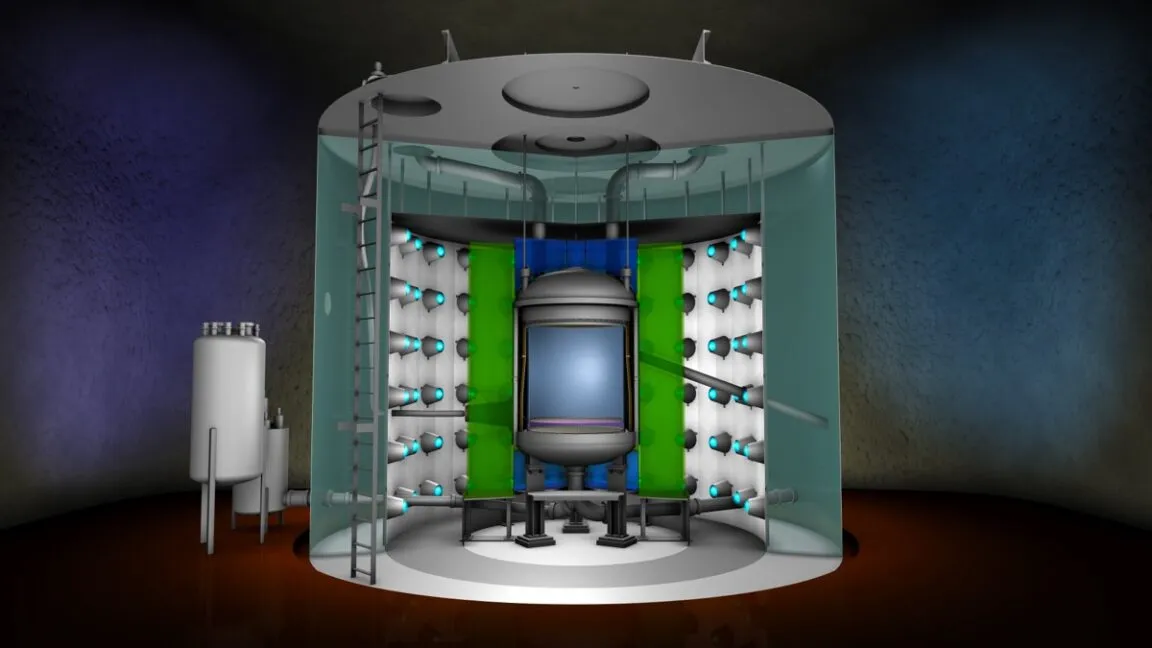
Could the LUX-ZEPLIN detector have found dark matter?
Physicists are investigating a potential signal that may represent the first glimpse of dark matter, a substance believed to constitute approximately 85 percent of the matter in the universe. The LUX-ZEPLIN detector, located in a South Dakota gold mine, reported an event that does not align with standard expectations for weakly interacting massive particles (WIMPs). According to a preprint available on arXiv (2026), the detected event showed a higher nuclear recoil energy than theoretical models typically predict.
The findings, presented at the 2026 TeV Particle Astrophysics conference in Japan, come with significant scientific caution. The signal is currently considered a 'hint' rather than a confirmed discovery, as it remains below the statistical threshold required to rule out a fluke. If the signal is indeed a WIMP striking a xenon nucleus, it challenges existing physics, as the detector failed to record the lower-energy interactions that should accompany such a high-energy event.
Theoretical implications of the LUX-ZEPLIN signal
The anomaly has prompted theoreticians to propose several new models to explain why the interaction rate might not follow traditional patterns. One possibility is that the interaction rate increases alongside collision energy. Another hypothesis suggests that WIMPs might possess an internal structure similar to an atom, requiring a specific energy threshold to interact. A third possibility is that the coupling between dark matter and ordinary matter is dependent on momentum. As data collection continues at LUX-ZEPLIN, the XENONnT laboratory in Italy, and the upcoming PandaX detector in China, the community awaits a definitive confirmation or refutation of this hint.
How has quantum entanglement been observed in Z bosons?
Researchers at the Large Hadron Collider (LHC) have successfully observed quantum entanglement in pairs of Z bosons, marking a high-energy milestone in particle physics. While entanglement is often studied in much smaller, controlled environments, the ATLAS experiment has demonstrated that large-scale particle colliders can serve as tools for investigating "spooky action at a distance." This phenomenon, famously described by Albert Einstein, allows disturbances in one particle to instantly affect another, regardless of the distance between them.
The Z bosons in this study were produced through the decay of Higgs bosons. Because Z bosons are extremely short-lived, the ATLAS detector had to precisely track their decay patterns into electron and muon pairs. By reconstructing the emission angles of these particles, physicists were able to infer the spins of the original Z bosons. According to a paper in Physical Review Letters (2026), this represents the highest-energy instance of entanglement ever recorded, providing new avenues for studying quantum mechanics at extreme scales.
Is yeast the secret to 3D-printing Martian homes?
Engineers from Hong Kong have developed a novel method for constructing habitats on Mars by combining Martian regolith with a biological "glue" made from yeast and gelatin. This approach addresses the prohibitive costs of transporting building materials from Earth to the Red Planet. The research, published in Chem Circularity (2026), describes a "living" building material that, when 3D-printed, hardens into a substance comparable in strength to low-grade concrete.
The technique leverages the unique environmental conditions of Mars, which mimic the freeze-drying process due to low temperature and pressure. The team used a specialized yeast coated in sticky proteins—similar to those found in mussels—to act as a binding agent within a gelatin scaffold. When the mixture is extruded through a 3D-printer nozzle, the Martian environment causes it to freeze-dry into a light, porous foam.
Structural viability of yeast-based Martian construction
Testing conducted under simulated Martian conditions showed that the resulting material possesses a compressive strength of 10 to 12 megapascals. To put this in perspective, this strength is sufficient to support one- or two-story buildings on Earth, where gravity is significantly stronger than on Mars. This makes the material highly viable for constructing larger, more complex structures on the Martian surface. Furthermore, this biological approach is less energy-intensive than traditional methods, such as melting Martian rocks into bricks, and offers the advantage of recyclability, as yeast could be recovered from old structures to create new ones.
Did Ice Age humans use psychoactive substances?
Archaeological evidence suggests that human use of mind-altering substances may date back much further than previously thought, potentially to the Late Pleistocene period. While the use of hallucinogens in religious or shamanic contexts is well-documented in Neolithic and later cultures, new findings from Indonesia suggest a much earlier timeline. According to a study in Science Advances (2026), humans may have been consuming psychoactive compounds via betel nuts as early as 25,000 years ago.
Archaeologists from Griffith University identified two rare forager skeletons from the island of Sulawesi with distinct, deep, rounded grooves in their teeth. These markings are consistent with the habitual sucking on whole betel nuts. By simulating the process in a laboratory, researchers concluded that soaking these nuts in saliva would release enough arecoline—a psychoactive compound—to alter brain function, albeit mildly. This consumption would result in increased alertness and a sense of euphoria.
The dental health cycle of ancient foragers
The use of betel nuts may have originated as a form of self-medication rather than purely for recreational or ritual purposes. Because arecoline acts as a natural analgesic, it is possible that early humans used the nuts to relieve tooth pain, a common issue in these populations. However, the abrasive nature of the seeds created a problematic cycle: the constant chewing wore down the teeth until the inner pulp chambers were exposed, leading to even more severe dental issues and necessitating continued use of the nut for pain relief.
Has a new technical description of Galileo’s telescope been found?
A recently discovered 17th-century manuscript has provided the most detailed technical analysis of a telescope attributed to Galileo Galilei. While historians generally credit Hans Lippershey with the invention of the telescope, Galileo's refinements were essential for his groundbreaking astronomical work. Because Galileo did not document his technical processes or sell his instruments, identifying his specific designs has historically been difficult. However, a study published in Annals of Science (2026) highlights a new breakthrough in this area.
The manuscript, titled De Tellescopiis Stellarum, was written in 1666 by a Spanish Dominican friar named Ignacio Muñoz. The text includes detailed diagrams and descriptions of a four-lens telescope. According to historian Jose Maria Moreno Madrid, the manuscript suggests that Galileo may have produced these instruments as gifts for King Philip IV of Spain to gain favor while working on solutions for determining longitude. If the timeline in the manuscript is accurate, it implies that Galileo's four-lens innovation occurred as early as 1630.
How were 19th-century "cosmoramas" used for real estate?
Beyond their role as immersive entertainment, 19th-century "cosmoramas" served as an early form of virtual reality for real estate marketing. Originally evolving from 17th-century "peep shows"—which used wooden cabinets and magnifying glasses to create depth—cosmoramas became popular gallery attractions in urban centers across Britain and Ireland. While they were widely enjoyed as a novelty, they also had a practical commercial application.
Research published in Early Popular Visual Culture indicates that these immersive displays allowed potential buyers to "tour" properties without leaving the gallery. By viewing detailed, three-dimensional perspectives of homes and landscapes, consumers could get a sense of a location's layout and surroundings. This use of visual technology represents an early intersection between mass entertainment and the burgeoning field of property marketing.
Frequently asked questions
What is the significance of the LUX-ZEPLIN dark matter hint?
The significance lies in the fact that the detected signal does not match current theoretical models for WIMPs. If confirmed, it would require physicists to rewrite theories regarding how dark matter interacts with ordinary matter, potentially revealing an internal structure or momentum-dependent coupling.
Why is Z boson entanglement important for quantum physics?
Observing entanglement in Z bosons is crucial because it demonstrates that quantum effects can persist at extremely high energy levels. This provides a new testing ground for quantum mechanics and helps scientists understand how entanglement behaves in the high-energy environments produced by particle colliders.
How does the yeast-based Martian material work?
The material works by using a mixture of Martian sand, gelatin, and specialized yeast. The yeast provides a sticky protein structure, while the gelatin acts as a scaffold. When 3D-printed in the low-pressure Martian atmosphere, the mixture freeze-dries into a strong, porous building material.
Why did ancient humans chew betel nuts?
Ancient humans likely chewed betel nuts for their analgesic properties to relieve tooth pain. However, the abrasive nature of the seeds caused significant dental wear, which likely created a cycle where the users needed to continue chewing the nuts to manage the resulting pain.
What makes the Muñoz manuscript unique for historians?
The Muñoz manuscript is unique because it provides a rare, detailed technical description and diagrams of a telescope attributed to Galileo. This offers a potential link to specific instruments Galileo may have manufactured for the Spanish monarchy, helping to clarify his technical contributions.
Key takeaways
- The LUX-ZEPLIN detector has found a potential dark matter signal that challenges current WIMP theories.
- Physicists observed high-energy quantum entanglement in Z bosons using the ATLAS detector at the LHC.
- A new 3D-printable Martian building material uses yeast and gelatin to create durable structures.
- Archaeological finds suggest humans used psychoactive betel nuts for pain relief 25,000 years ago.
- A 1666 manuscript provides the most detailed known technical description of a Galileo-made telescope.
Synthesis and perspective
The scientific landscape of 2026 is characterized by a bridge between the ancient and the futuristic. While archaeologists uncover the psychoactive habits of Pleistocene foragers and historians rediscover the technical genius of Galileo, engineers are looking toward Mars to build the next era of human habitation. Simultaneously, the frontiers of physics continue to push boundaries, with the LHC and LUX-ZEPLIN probing the fundamental mysteries of entanglement and dark matter. Together, these breakthroughs demonstrate that whether we are looking deep into the past or far into the cosmos, the tools of scientific inquiry continue to reveal a universe far more complex and interconnected than previously imagined.