How does the Every Electric battery program work for residents?
The program operates by providing households with portable battery units that act as a buffer between the home's appliances and the electrical grid. Residents receive the batteries, plug them into a standard wall outlet, and then connect their window air conditioning units directly to the battery's AC sockets. This setup allows the air conditioner to run on stored energy during periods of high electricity demand, effectively making the appliance 'drop off the grid' without the resident losing comfort.
The process is managed through a combination of hardware and software. Once the batteries are connected to the home's Wi-Fi, Every Electric manages the charging cycles remotely. The units are programmed to charge during low-demand periods, typically at night, and discharge their stored energy when the utility company, Con Edison, identifies peak demand periods. This automation ensures that the grid is supported exactly when it needs it most, while the resident enjoys continuous cooling.
Financial incentives and participation models
Every Electric utilizes a dual-incentive model to encourage participation and sustain its operations. For many apartment renters, the company offers a loaner program where batteries are provided for free in exchange for a temporary deposit. This deposit, which has been reduced from $50 to $30 per battery, is fully returned when the equipment is sent back. Alternatively, residents who prefer ownership can purchase the units outright for $650 each.
The financial benefit to the user comes through Con Edison’s Smart Usage Rewards program. As a partner, Every Electric receives payments from the utility for the flexibility provided to the grid and shares a portion of these earnings with the participating households. The company estimates that residents can earn roughly $150 annually for every air conditioner they power through the system. This revenue-sharing model is designed to make residential energy storage accessible to a wide demographic, particularly in high-density urban environments.
What are the technical specifications of the Bluetti units?
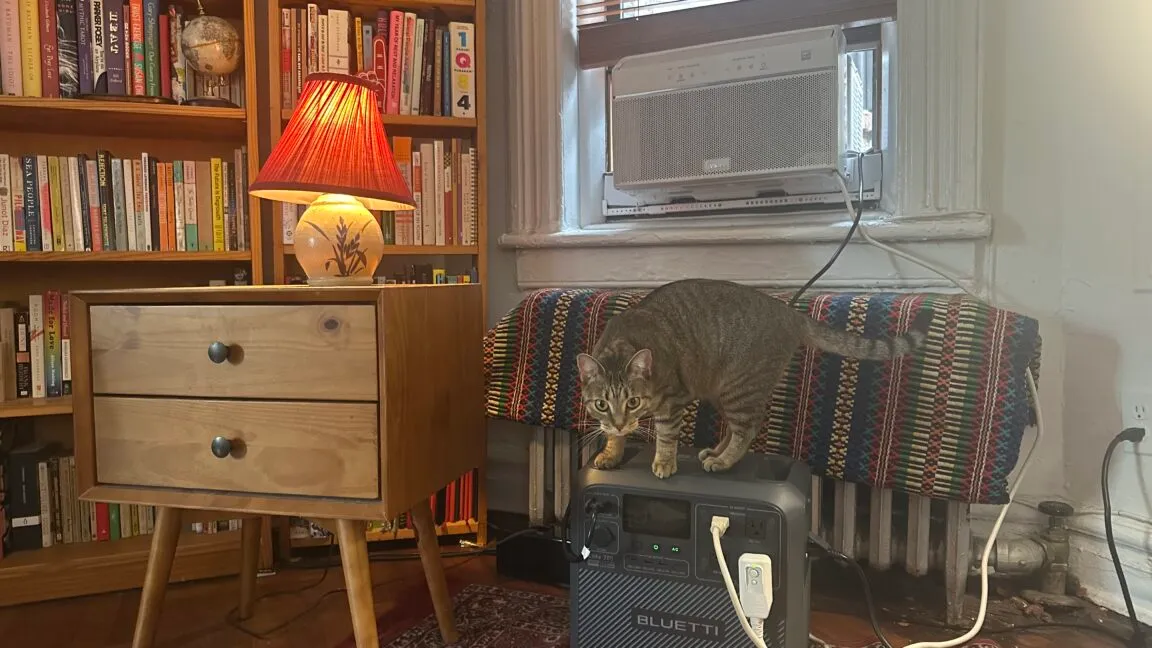
The hardware chosen for this initiative is the Bluetti Elite 200 V2, a lithium iron phosphate (LiFePO4) battery designed for residential stability and compact storage. Each unit holds 2 kilowatt-hours (kWh) of energy, making it suitable for the spatial constraints of New York City apartments. The choice of LiFePO4 chemistry is significant for safety and longevity in a household setting.
The battery serves as a versatile power hub for various household needs. Beyond powering a standard 120V window air conditioner, the unit features four AC sockets that can support other appliances like fans or air purifiers. It also includes modern connectivity options, such as USB-A and USB-C ports for charging laptops and smartphones, as well as a 12V DC outlet similar to those found in vehicles. This versatility allows the battery to function as a reliable backup power source during local outages, capable of keeping essential devices like Wi-Fi routers or refrigerators operational.
Why is this model considered a virtual power plant?
Every Electric is transforming individual household batteries into a collective resource known as a virtual power plant (VPP). Instead of relying on a single, massive, utility-scale battery installation, the company distributes the storage capacity across thousands of homes. This decentralized approach provides the grid with the same flexibility as a traditional power plant but with much higher geographic distribution.
The scale of this distributed network is significant. In the summer of 2026, Every Electric deployed 2,000 batteries across approximately 1,000 households, providing a total of four megawatt-hours (MWh) of energy storage. To put this in perspective, a single large-scale, containerized utility battery typically holds about four MWh. By breaking this capacity into 1,000 smaller pieces spread throughout New York City, the startup creates a resilient and flexible energy resource that can respond to local grid stresses in real-time.
Addressing infrastructure challenges in older buildings
Implementing a VPP in a city like New York presents unique electrical engineering challenges, particularly due to the age of the housing stock. More than 80% of New York City buildings were constructed over 50 years ago, meaning many rely on older wiring and window-mounted cooling systems rather than modern central air conditioning.
One notable challenge involves the risk of tripping circuit breakers. During extreme heat events, when Con Edison may reduce voltage to protect grid equipment, the sudden power draw from the batteries can occasionally overwhelm older residential wiring. Every Electric has addressed this by continuously updating the battery firmware to fine-tune how the units draw and discharge power, ensuring they operate within the specific electrical parameters of diverse, often aging, household environments.
How has the program scaled since its inception?
The company has seen rapid growth since its pilot phase in 2025. The initial test run involved only 100 batteries distributed across 65 households. However, the demand for the service has surged, with a waitlist reaching over 15,000 requests during the summer of 2026. This growth reflects a significant interest in decentralized energy solutions among urban renters and homeowners alike.
Looking forward, Every Electric has set an ambitious target to have more than 10,000 batteries deployed by 2027. While the company remains focused on the New York City market, the success of the model is attracting interest from other utility territories. The ability to 'drop-ship' megawatt-hours directly to consumers via residential hardware is a model that the company intends to map onto new markets across the United States.
Frequently asked questions
How much can I earn from the program?
Participants can generally expect to earn approximately $150 per year for each air conditioner connected to the battery. These earnings are processed through Every Electric online accounts, which are linked to the Con Edison Smart Usage Rewards program, ensuring a streamlined payment process for the resident.
Is there a cost to use the batteries?
The program offers a free loaner option for residents. To participate, users provide a temporary deposit of $30 per battery, which is fully refunded when the battery is returned. Alternatively, users have the option to purchase the Bluetti Elite 200 V2 units outright for $650.
Can the battery power devices other than air conditioners?
Yes, the Bluetti Elite 200 V2 is highly versatile. It includes four standard AC sockets for appliances like fans or purifiers, USB-A and USB-C ports for electronics, and a 12V DC outlet. It can also serve as an emergency backup for refrigerators and Wi-Fi routers during outages.
What happens if the battery trips my circuit breaker?
In some older buildings, the power draw may occasionally trip a circuit breaker. Every Electric manages this by using remote firmware updates to adjust how the batteries interact with the home's electrical system, helping to mitigate issues caused by older wiring or voltage fluctuations.
Is the battery safe for home use?
The batteries use lithium iron phosphate (LiFePO4) chemistry, which is known for its stability. Additionally, the units are compact and designed for unobtrusive placement in residential living spaces. Interestingly, the company has even noted that the slight warmth generated by the units makes them popular resting spots for household pets.
Key takeaways
- The Every Electric program provides free battery loans to NYC residents to power air conditioners.
- Participants can earn an estimated $150 annually per air conditioner through Con Edison rewards.
- The system uses Bluetti Elite 200 V2 batteries, offering 2 kWh of energy storage.
- The distributed network acts as a virtual power plant, providing megawatt-hours of grid flexibility.
- The company aims to expand from 2,000 to over 10,000 deployed batteries by 2027.
Conclusion
The Every Electric battery program represents a significant shift in how urban energy grids can be managed. By leveraging residential storage through a virtual power plant model, the startup provides a dual benefit: reducing grid strain during critical heat events and providing tangible financial rewards to residents. As the company scales its deployment and refines its technology to accommodate older building infrastructures, this decentralized approach offers a scalable blueprint for modernizing energy consumption in dense metropolitan areas across the country.