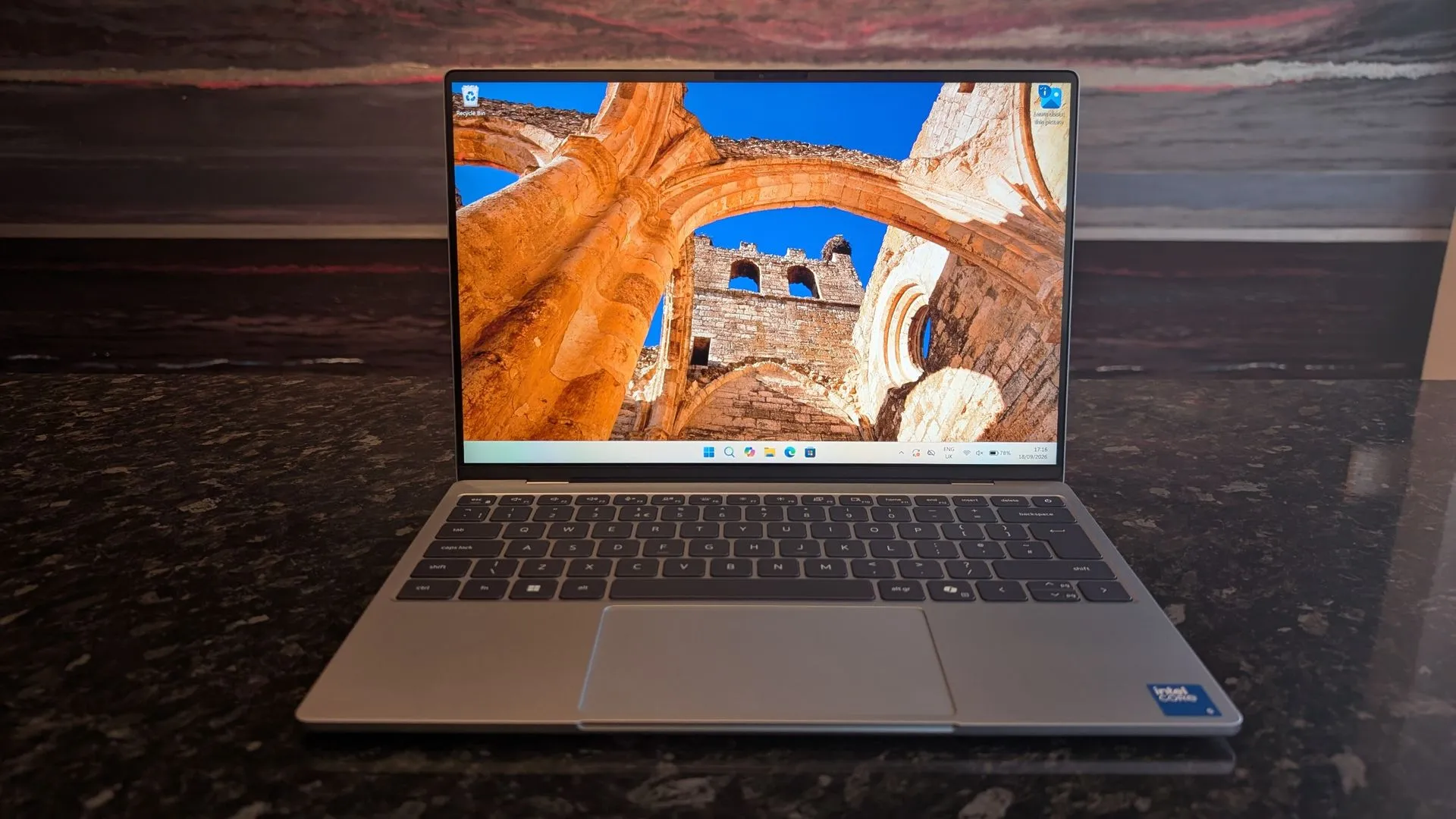
What are the core specifications of the 2026 Dell XPS 13?
The 2026 Dell XPS 13 is built around the Intel Core 5 320 (Wildcat Lake) processor, a six-core chip capable of reaching boost speeds of up to 4.6GHz. This processor is paired with integrated Intel graphics and a dedicated Neural Processing Unit (NPU) rated at 16 TOPS, which assists with AI-driven tasks. To support productivity, the machine includes 16GB of LPDDR5X-7467 memory and a 512GB PCIe SSD for storage.
The display is a standout feature, utilizing a 13.4-inch 3K touchscreen with a resolution of 2560 x 1600 and a 120Hz refresh rate. This ensures smooth visuals and high pixel density for detailed work. Connectivity is handled via Wi-Fi 7 and two USB-C ports, providing modern wireless speeds and standard high-speed wired connections.
When analyzing these specs, the combination of high-speed LPDDR5X memory and the 120Hz refresh rate suggests a device optimized for fluid multitasking and visual clarity. While the storage is a standard 512GB, the inclusion of PCIe technology ensures that file access and system boot times remain snappy for the everyday professional.
Hardware Performance and AI Integration
While the integrated Intel graphics are sufficient for everyday productivity and light media consumption, the inclusion of an NPU with 16 TOPS signals Dell's intent to capture the growing market for AI-enhanced software. Users can expect improved efficiency in tasks such as background noise cancellation, video conferencing enhancements, and certain creative workflows that leverage local machine learning models.
The Core 5 320 processor acts as the engine for these capabilities, balancing power with the thermal constraints of an ultra-slim chassis. The 16 TOPS rating for the NPU is a specific metric that places this laptop within the modern era of AI-capable hardware, even if the integrated graphics remain focused on efficiency rather than heavy gaming or high-end 3D rendering.
However, the source leaves it unsettled exactly how much these AI capabilities will impact battery life over long periods of use, or how much the NPU will be utilized by standard consumer software in the immediate future. For now, it stands as a forward-looking inclusion in a productivity-focused machine.
How does the Dell XPS 13 compare to the MacBook Neo?
The Dell XPS 13 is positioned as a primary rival to Apple's new budget-friendly MacBook Neo. According to Techradar expert Christian, the XPS 13 returns with an entirely new design and a lower price point intended to challenge Apple's dominance in the premium ultrabook segment. While the MacBook Neo targets the entry-level premium market, the XPS 13 attempts to bridge the gap between high-end build quality and accessible pricing.
In his three-and-a-half-star review, Christian noted that while Dell's move to a lower price point is a "bold move," the company "doesn't quite stick the landing." This suggests that while the value proposition is strong, the design execution or user experience may still face hurdles when compared to the polished ecosystem of macOS.
The competition between these two devices often comes down to the operating system preference. For users who require the Windows ecosystem for specific professional software or a more flexible file management system, the XPS 13 provides a premium alternative to the macOS experience. The choice for many will ultimately hinge on whether they prioritize the specific design language of the new XPS or the established workflow of the MacBook Neo.
Is the portability of the XPS 13 sufficient for mobile professionals?
Portability is the central pillar of the XPS 13 design, with the device weighing just 2.2lb and measuring only 0.5 inches in thickness. This makes it an ideal candidate for professionals, remote workers, and students who frequently move between locations, such as commuting or traveling. The slim aluminum chassis maintains a premium feel without the bulk typically associated with high-performance laptops.
The high-resolution touchscreen further enhances its utility for mobile users, allowing for intuitive navigation in environments where a mouse might be impractical. This combination of weight and screen quality is specifically tailored for those who need to maintain high productivity while working from cafes, planes, or transit.
However, the extreme thinness of 0.5 inches is a double-edged sword. While it enables the 2.2lb weight, it necessitates the minimalist approach to ports and expandability that defines this model. Mobile professionals must decide if the ease of carrying the device outweighs the potential friction of needing extra adapters.
Connectivity and Expandability Limitations
The pursuit of an ultra-slim profile has resulted in a minimalist port selection. The laptop features only two USB-C ports, which may prove restrictive for users who need to connect multiple external drives, monitors, or legacy peripherals simultaneously. Furthermore, the 16GB of LPDDR5X memory is soldered to the motherboard and is not expandable.
Users who anticipate needing 32GB or more for heavy multitasking or specialized professional applications should look for alternative models, as the XPS 13 is designed for a fixed-specification experience. The lack of expansion means that the hardware you purchase today is the hardware you will have for the life of the device.
Because of these limitations, the source suggests that a hub or dock could quickly become a necessity for many users. This is a critical consideration for anyone intending to use the XPS 13 as a primary desktop replacement in a home office setup.
What is the value proposition of the current Best Buy deal?
The current Best Buy promotion offers the Dell XPS 13 at $799.99, representing a $200 reduction from the $999.99 price and a significant drop from its $899 launch price. This pricing strategy makes the 2026 model highly competitive in the sub-$800 premium category, where most options are either significantly less portable or lack high-resolution displays.
The value is driven by the combination of several high-end attributes: the 3K 120Hz touchscreen, the premium aluminum construction, and the lightweight chassis. For a student or a remote worker, obtaining these features at the $800 mark provides a high performance-to-price ratio that is difficult to find in other Windows ultrabooks.
When compared to the launch price of $899, this $799.99 deal represents a deeper discount than initially expected, making it a "terrific reduction" for those seeking a premium Windows experience. However, buyers must factor in the potential cost of peripherals like USB-C hubs to ensure they have the connectivity they require.
Frequently asked questions
Is the RAM upgradeable on the Dell XPS 13?
No, the 16GB of LPDDR5X memory in the Dell XPS 13 is not expandable. Because the memory is integrated into the system, users must select the appropriate amount of RAM at the time of purchase, as they cannot add more later to support heavier workloads.
What kind of ports does the Dell XPS 13 have?
The Dell XPS 13 is equipped with two USB-C ports. Due to its extremely slim 0.5-inch design, it lacks traditional USB-A or HDMI ports. Users requiring more connections will likely need to use a USB-C hub or a docking station to expand their connectivity.
Does the Dell XPS 13 support Wi-Fi 7?
Yes, the 2026 model of the Dell XPS 13 includes Wi-Fi 7 support. This provides users with access to the latest wireless standards, offering faster data speeds, lower latency, and improved reliability in crowded network environments, which is beneficial for remote work.
Who is the ideal user for this laptop?
The ideal user is a professional, student, or remote worker who prioritizes portability and display quality. It is specifically designed for those who work on the move and require a lightweight, premium Windows device with a high-resolution touchscreen for productivity.
How does the processor perform for everyday tasks?
The Intel Core 5 320 processor is well-suited for everyday productivity tasks. With six cores and a boost clock of 4.6GHz, it handles multitasking, web browsing, and office applications efficiently, while the NPU provides specialized support for modern AI-driven software features.
Key takeaways
- The Dell XPS 13 (2026) is currently discounted to $799.99 at Best Buy.
- It features a 13.4-inch 3K touchscreen with a 120Hz refresh rate.
- The device weighs 2.2lb and is only 0.5 inches thick for high portability.
- The laptop uses an Intel Core 5 320 processor with a 16 TOPS NPU.
- Connectivity is limited to two USB-C ports and non-expandable 16GB RAM.
Conclusion
The Dell XPS 13 (2026) represents a strategic attempt by Dell to capture the premium Windows market by competing directly with Apple's entry-level offerings. While the limited port selection and non-expandable memory may deter power users, the current $200 discount at Best Buy significantly enhances its appeal for the general professional and student demographic. For those who value a lightweight, high-resolution, and highly portable Windows experience, the XPS 13 at the $799.99 price point offers a compelling balance of design and performance that is difficult to ignore in the current ultrabook landscape.